
Herodotus Philobarbaros

I have been re-reading Herodotus during my Spring Break with the intention of returning to my long-neglected book project. I first read The Histories (which really should be translated “the researches” or “the inquiries”), on a long backpacking trip some years ago, but I got very little out of the experience.
The eponymous character in Michael Ondaatje’s novel, The English Patient, carries an annotated copy of Herodotus with him and it serves as a kind of motif for the exploration of history and memory. I had hoped to recapture some of that novel’s romance in my own reading, and it was there in small measure, but there was also so much that I completely missed.
Herodotus draws the contemporary reader into an alien world, far too rich for the non-specialist; nearly every line would benefit from a lengthy annotation. So this time around, I’m listening to Elizabeth Vandiver’s lectures alongside the book and that is helping tremendously.
For my project, I am interested in Herodotus for a few reasons: (1) for his distinctly pre-Platonic moral relativism, (2) for his related admiration of foreign/barbarian cultures, and (3) for his discussion of tyranny and general analysis of “good” and “bad” rule.
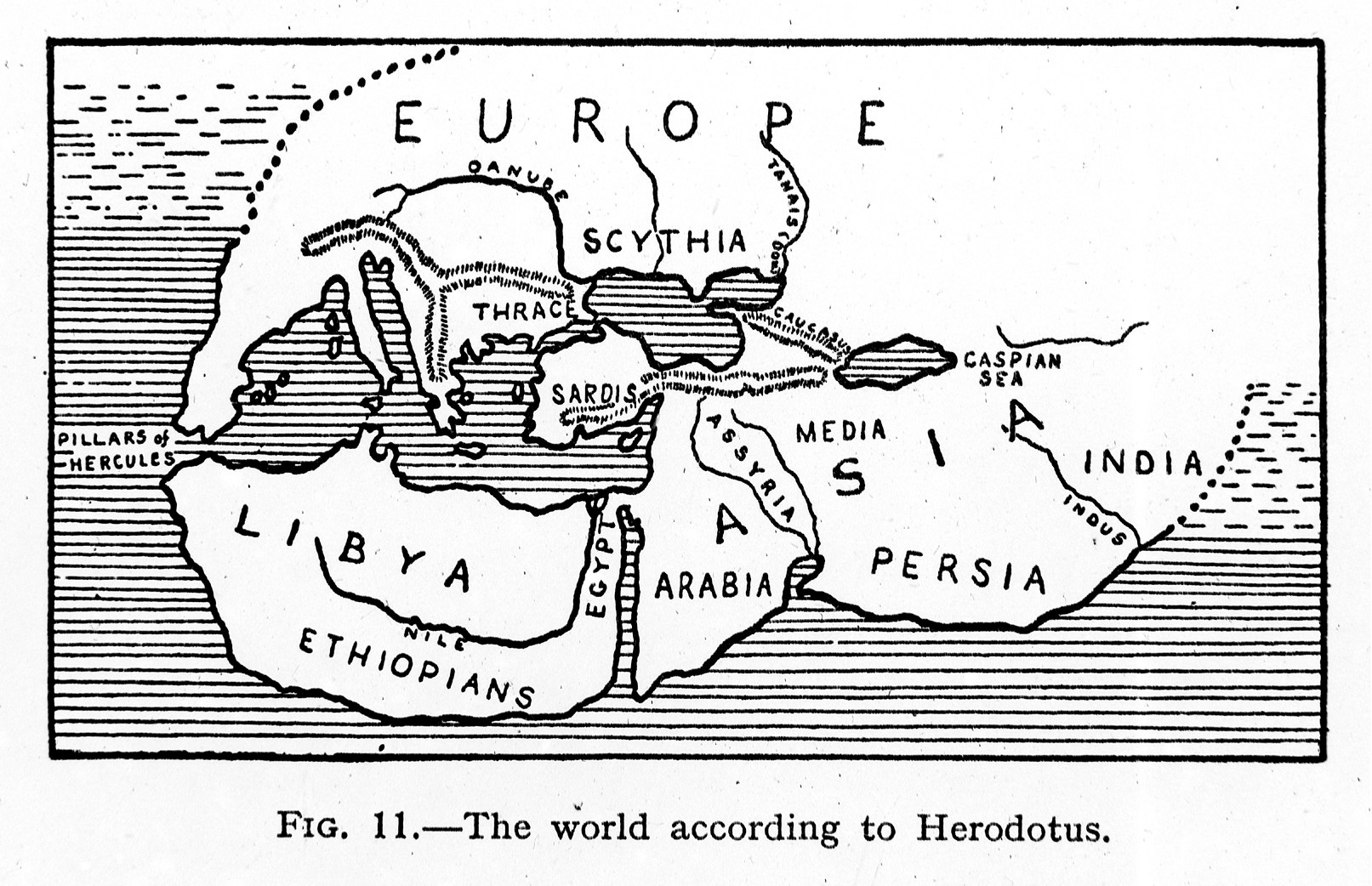
Herodotus is usually held to be a fairly straightforward moral relativist, presenting stories and practices from all over the world that he knew (see image below) without passing moral judgment about any of it. This is not quite true, but one way of reading The Histories is as an extended meditation on the classical contrast between φύσις and νόμος, i.e., between nature and convention. Or as we often say today, nature versus nurture.
Herodotus does not advance anything like the systematic account of ethics that we find in Plato and Aristotle, of course. Rather, his moral ideas lie in the assumptions and subtext revealed by the stories he recounts. And The Histories is replete with anecdotes, curiosities and tall tales.
Among Greeks, there was perhaps nothing more amusing than hearing about Egypt’s “peculiar” practices, such as women urinating while standing up, which Herodotus reports in his matter-of-fact style. He confronts foreign customs with curiosity and rarely pauses to give his opinion on anything except for a brief commentary where the facts are in question or where accounts vary. He seems mainly concerned with highlighting the vast array of human cultural diversity.
A famous passage from Book 3.38:
I hold it then in every way proved that Cambyses was quite insane; or he would never have set himself to deride religion and custom. For if it were proposed to all nations to choose which seemed best of all customs, each, after examination, would place its own first; so well is each convinced that its own are by far the best. [my emphasis]
It is not therefore to be supposed that anyone, except a madman, would turn such things to ridicule. I will give this one proof among many from which it may be inferred that all men hold this belief about their customs.
When Darius was king, he summoned the Greeks who were with him and asked them for what price they would eat their fathers’ dead bodies. They answered that there was no price for which they would do it.
Then Darius summoned those Indians who are called Callatiae, who eat their parents, and asked them (the Greeks being present and understanding through interpreters what was said) what would make them willing to burn their fathers at death. The Indians cried aloud, that he should not speak of so horrid an act. So firmly rooted are these beliefs; and it is, I think, rightly said in Pindar’s poem that custom is lord of all.
Custom is lord of all.
This is classic moral relativism. We are presented with different views and Herodotus declines to judge the superior. Everyone will inevitably disagree. For the close reader, however, one does find Herodotus occasionally passing judgement—and it tells us something about his moral assumptions.
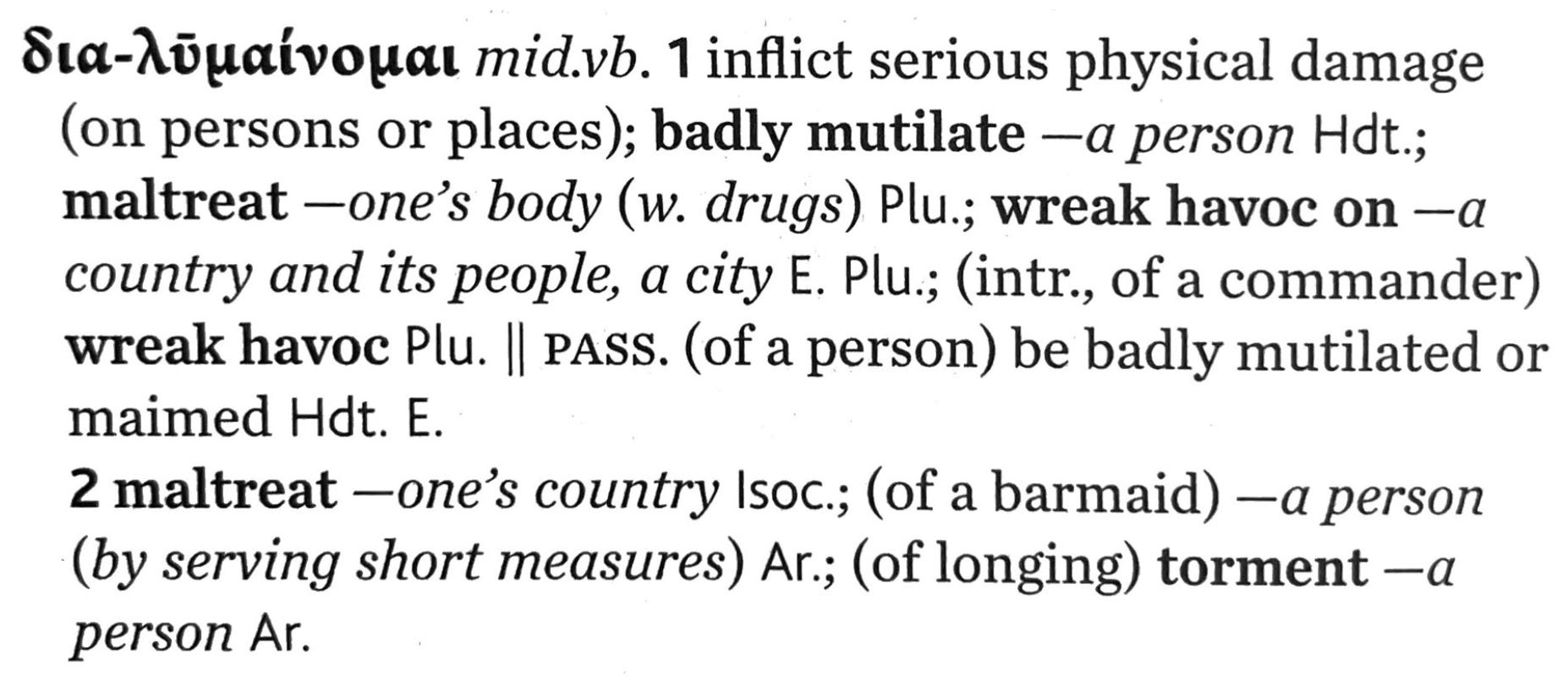
For instance, he editorializes on the “cruel” treatment of Masistes’ wife at the hands of Amestris: “she cut off the woman’s breasts and threw them to dogs, and her nose and ears and lips also, and cut out her tongue. Then she sent her home after she had undergone this dreadful ordeal. [διαλελυμασμένην].” (
The key verb here is διαλυμαίνομαι, which bears negative moral connotations. That Herodotus uses this word is revealing.
Something about this incident seems to have disturbed him more that usual. Elsewhere, he recounts acts of shocking brutality with all the descriptive composure of a journalist. Violence rarely unsettles him. With the notable exception of the passage above, one gets the distinct impression that he is more disturbed by an account of a woman engaging in sexual acts with a goat (“a monstrous thing”) than by the many examples of cannibalism presented simply as evidence of the malleability of human culture and custom!
In other part of the book, Herodotus not only reports on the diverse practices of “barbarian” cultures, he openly admires them and occasionally declares them superior to Greek traditions. He describes the accomplishments of the Egyptian pharaohs and the splendor of their realm before its subjugation by Persia. He clearly regards Egyptian civilization as vastly older and more important. He depicts Persian administrative practices as more efficient than the decentralized Greek poleis.
The term barbarian will of course come to be a pejorative, but no such value judgment sullies Herodotus’ use of the word. He simply means non-Greek-speaking peoples. (As my students always find amusing, the word βάρβαρος is onomatopoeic, i.e., those whose language sounds like “bar-bar-bar-bar” to Greek ears.)
Not until Montaigne do we find a write with a similar willingness to look squarely and critically at one’s own culture in comparison with another.
And it is for this reason, centuries later, that Plutarch castigates Herodotus in his polemic, “On the Malice of Herodotus” (Περὶ τῆς Ἡροδότου κακοηθείας), calling him a foreigner-lover, a philobarbaros. It is an ugly word and not Plutarch’s best moment.
He attacks Herodotus for his distortion of facts and his “malicious” intent in slandering the Greeks by deliberately misrepresenting historical events, especially those related to the reputation of Plutarch’s home city of Boeotian Thebes. But philobarbarism is clearly the main charge.
The style, O Alexander, of Herodotus, as being simple, free, and easily suiting itself to its subject, has deceived many; but more, a persuasion of his dispositions being equally sincere. For it is not only (as Plato says) an extreme injustice, to make a show of being just when one is not so; but it is also the highest malignity, to pretend to simplicity and mildness and be in the mean time really most malicious. Now since he principally exerts his malice against the Boeotians and Corinthians, though without sparing any other, I think myself obliged to defend our ancestors and the truth against this part of his writings, since those who would detect all his other lies and fictions would have need of many books.
To this jingoistic chauvinism, we can reply with a quote from Montaigne, who I think must have had Herodotus in mind:
“[E]very one gives the title of barbarism to everything that is not in use in his own country.”