
Crying Wolf on Antisemitism
A lawsuit in Kentucky may soon test the IHRA definition of antisemitism.

The IHRA working definition of antisemitism has gotten a lot of attention recently, especially given the renewed zeal with which the Trump administration has sought to suppress all criticism of Israeli policy.
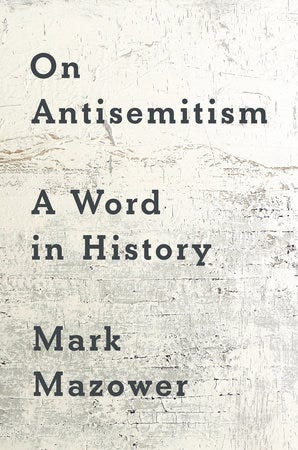
Mark Mazower, whose work I admire, recently published a short book on antisemitism in which he spends some time on the IHRA definition. As he notes, the Oxford English Dictionary (OED) defines antisemitism as:
Prejudice, hostility, or discrimination towards Jewish people on religious, cultural, or ethnic grounds.
A straightforward and unobjectionable definition.
By contrast, the IHRA “working definition” defines antisemitism as:
A certain perception of Jews, which may be expressed as hatred toward Jews. Rhetorical and physical manifestations of antisemitism are directed toward Jewish or non-Jewish individuals and/or their property, toward Jewish community institutions and religious facilities.
Somebody consult Strunk and White!
As Mazower observes, the IHRA definition uses “nearly three times as many words as the OED” yet it “says less and does so less clearly.”
In just its first sentence, the word certain is not needed; perception is an imprecise term; may be is odd since a definition generally tells us what something is; and hatred is not the only and not necessarily even the most important expression of antisemitism. … [C]ompared to the OED version, the IHRA definition is poorly crafted and not really a definition at all.
So, not really a definition at all…
As Mazower also observes, the ambiguity is almost certainly the point.
And yet, this non-definition has been “embraced on a scale vastly disproportionate to its merits.”
By 2024, at least 37 U.S. states adopted the non-binding definition (I am told by Sindre Bangstad, distinguished visiting professor at Princeton, that this figure may have risen as high as 46 in 2025). More than 45 countries have endorsed it as well (including the United States, Canada, Germany, the United Kingdom, and France), not to mention 1,250+ municipalities and private organizations. In February 2024, the heads of twenty-seven national Jewish groups urged Congress in an open letter to enshrine the definition in law. Fortunately, this has not happened. (Not yet anyway.)
For Israel, the definition has some pretty obvious advantages.
“[A]s a shield deflecting foreign policy criticism while presenting itself as a means to combat hate crime, the IHRA definition of antisemitism provides the kind of armor many countries would like to have. One can easily imagine, for instance, how advantageous the Kremlin would have found it to have been able to watch the US clamp down on anti-Russian speech in 2022.”
The popularity of such a muddled definition would be puzzling were it not for its utility. Ambiguity creates room for overreach, and overreach has become the point.
As the Trump administration continues to target universities with frivolous civil rights complaints, some have agreed to adopt the IHRA definition—including Harvard.
In January this year, Harvard settled two lawsuits alleging campus antisemitism by formally incorporating the IHRA definition into its nondiscrimination and anti-bullying policies, and by committing to apply that definition in its disciplinary and Title VI processes.
As I have written before, Title VI—the section of the Civil Rights Act barring discrimination on the basis of race/ethnicity/national origin—is being abused by college administrations to smear all criticism of Israel as antisemitic. As more campuses adopt the deliberately (and conveniently) unclear IHRA definition, this problem will only get worse.
By far the most controversial aspect of the IHRA definition is that it seems to both allow and disallow criticism of Israel.
On the one hand it notes that “criticism of Israel similar to that leveled against any other country cannot be regarded as antisemitic.”
Reasonable enough.
On the other hand, it also suggests that the following are antisemitic:
“[C]laiming that the existence of a State of Israel is a racist endeavor.”
“Drawing comparisons of contemporary Israeli policy to that of the Nazis.”
This is outrageous on its face and no one who cares about academic freedom can accept it.
Many other nations (Australia, New Zealand, the United States, etc.) are often described as having racist origins. If people are not prevented from making such statements, why should Israel be exempt? Wouldn’t this exemption itself constitute a double-standard, albeit in the opposite way intended? I won’t spend time picking apart the wording, because we have a better source of critique.
Kenneth Stern, one of the authors of the IHRA definition, has stated that it “was never intended as a tool to target or chill speech on a college campus.” As he also notes, the definition has absurdly been used to label Jewish students who oppose Israel’s actions in Gaza as antisemitic!
The American Association of University Professors argues that new legislative efforts to redefine antisemitism using the IHRA definition constitute “a state-imposed orthodoxy that prohibits or discourages faculty members and students from engaging in academic work that may question the state’s positions on Israel or Zionism.”
Such laws, the AAUP warns, are unconstitutional forms of state censorship that violate academic freedom, chill research and teaching, and undermine the core mission of higher education.
I couldn’t agree more, but the IHRA definition has yet to meet a legal test in court.
Fortunately, such a test may be in the works.
My friend and colleague Ramsi Woodcock recently sued the University of Kentucky for punishing him over his outspoken opposition to Israel’s genocide in Gaza. The university has treated him, a tenured legal scholar, appallingly and he should be immediately reinstated. I hope this happens soon. I am encouraged that the Foundation for Individual Rights and Expression (FIRE) is supporting him. They have supported me in the past as well.
Part of the lawsuit specifically challenges the constitutionality of the IHRA definition on First Amendment grounds and calls on the Department of Education Secretary Linda McMahon to “refrain from requiring or using” the IHRA definition when enforcing Title VI.

I recommend reading the full complaint, which Ramsi has made available on his website. Here are a few excerpts that deal with the core of the constitutional question:
23. The IHRA definition characterizes as “antisemitic” at least three categories of non-discriminatory political speech:
“Drawing comparisons of contemporary Israeli policy to that of the Nazis”;
“Denying the Jewish people their right to self-determination, e.g., by claiming that the existence of a State of Israel is a racist endeavor”;
“Applying double standards by requiring of [Israel] a behavior not expected or demanded of any other democratic nation.”
24. The Nazi comparison category represents non-discriminatory political speech because all peoples and states, regardless of religious affiliation or ancestry, are capable of following bad policies, including policies comparable to those of the Nazis. Speech falling in this category therefore does not target Israel based on its claimed Jewish character. To proscribe this speech would grant to Israel an exemption from criticism not enjoyed by any other state.
25. The self-determination category prohibits discussion of the extent to which Jewish people as a group have a right to self-determination in Palestine, and prohibits the application of universally- applicable rules and principles, including the international norm against colonization and international prohibitions on segregation and apartheid, to this question. To proscribe this speech would grant to the Zionist movement and Israel an exemption from criticism not enjoyed by any other nationalist movement or state.
26. The double standards category sweeps in non-discriminatory political speech because Israel may violate a standard that does not target Jewish people, but which no other democratic nation happens to violate. To call for an end to all Western colonies in the Middle East requires of Israel a behavior (dissolution), not required of any other democratic country. But it would require of Israel a behavior required of all other Western colonies in the Middle East—and not long ago there were many. So, again, the standard would not discriminate against Israel based on its claimed Jewish character.
27. “Title VI does not and cannot constitutionally prohibit criticism of Israel.”
31. Kenneth Stern, one of the drafters of the IHRA definition, has stated that “[t]he IHRA working definition of antisemitism that is being adopted as a de facto hate speech code at universities around the country was never intended to be used to determine whether speech should be disciplined. It was never intended to be used by campus administrators at all.” He has lamented that “the working definition has been primarily used (and I argue, grossly abused) to suppress and chill pro-Palestinian speech.”
77. To the extent that the IHRA definition prohibits calling for the dismantling of colonial state structures, prohibits legal scholars from debating the contours of the right of self-determination, prohibits allegations of race discrimination, and prohibits allegations of genocide, the IHRA definition is unconstitutional.”
In short, Ramsi argues that the IHRA definition, when used to police campus speech, is tantamount to a “prohibition of broad categories of political speech.”
As a public institution, the University of Kentucky is bound by the First Amendment in a way that private universities are not. That alone makes this case important: the university cannot lawfully enforce a speech code (much less a vague “working definition”) that punishes political expression.
It is possible that the university will seek to settle before any ruling is issued, sparing itself further scrutiny and leaving the constitutional question unaddressed.
Does the adoption of the IHRA “working definition” violate the First Amendment?
If the case proceeds, we may get an answer. Ⓐ
Brilliant post. Thank you.
Thank you for your important contribution!